

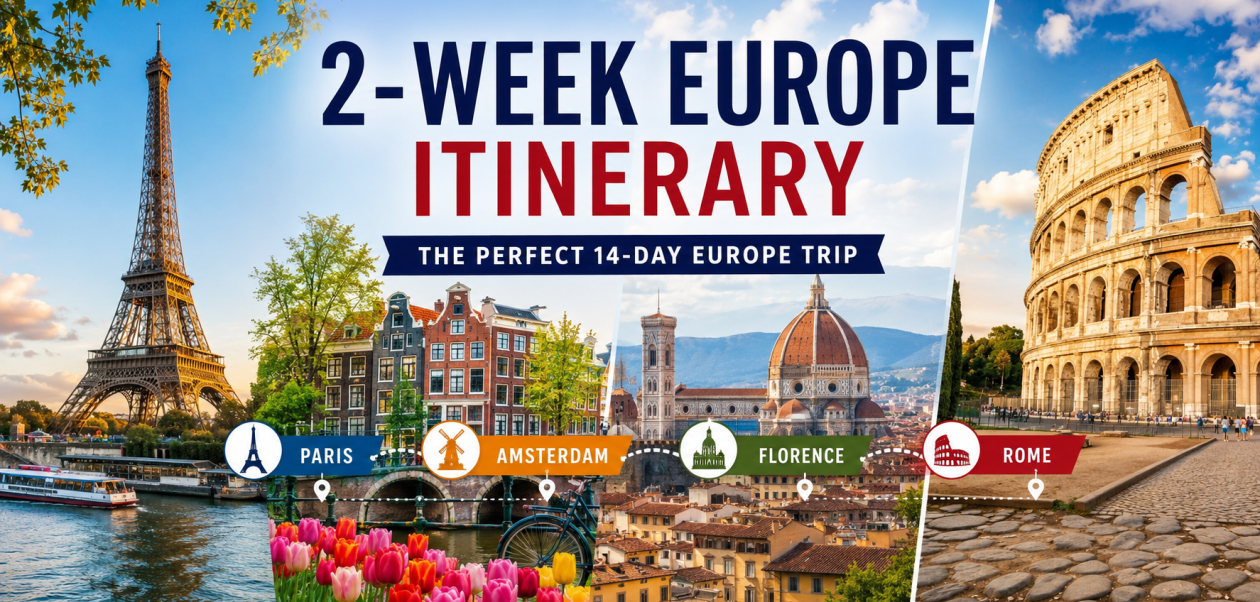
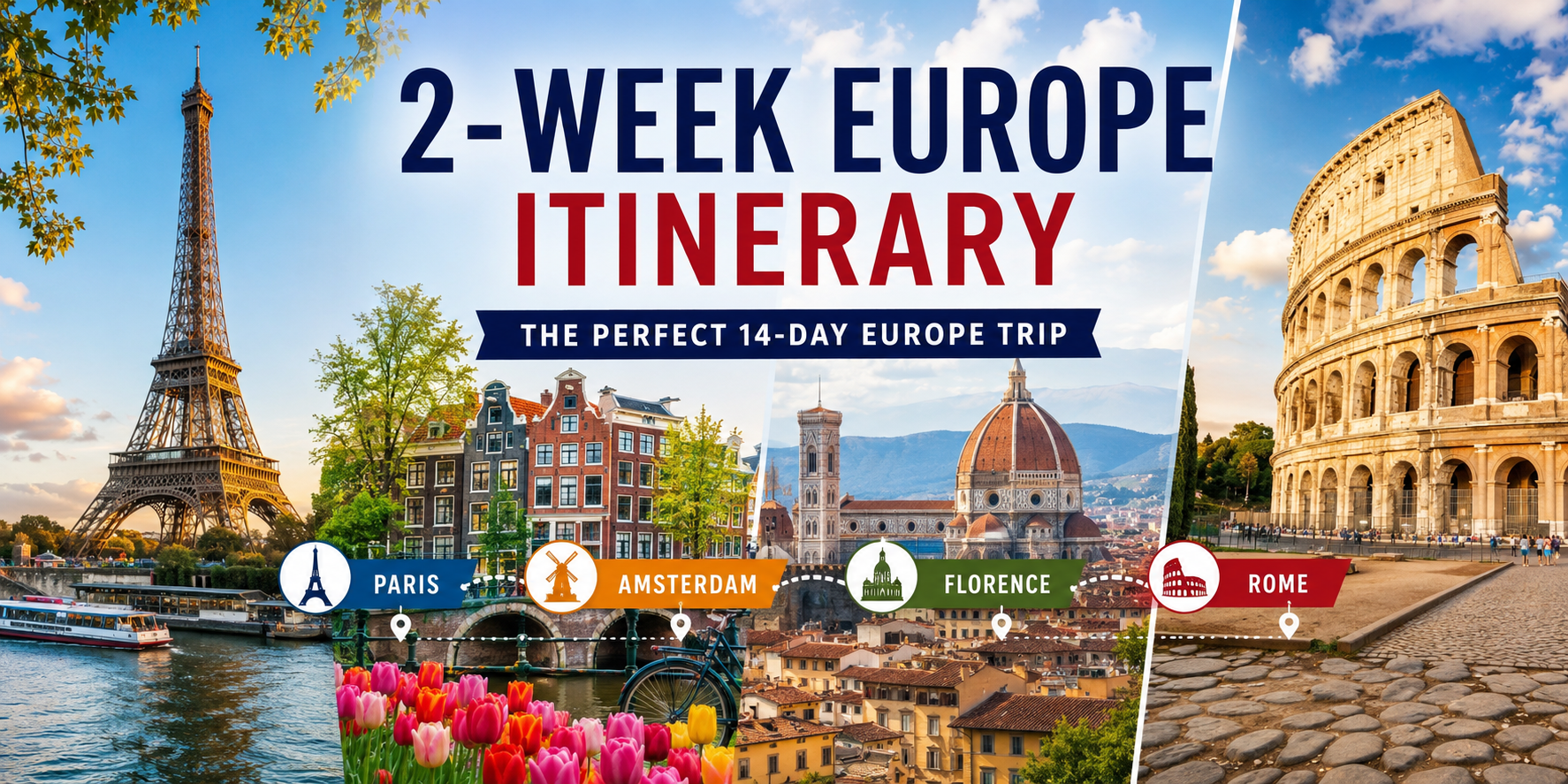
Europe is compact compared with many other long-haul destinations, but that doesn’t mean every city is close or that travel between them is effortless.
This itinerary deliberately limits the number of destinations to four.
You’ll experience:
- 🇫🇷 Parisian architecture, museums, and cafés
- 🇳🇱 Amsterdam’s canals and historic neighborhoods
- 🇮🇹 Florence’s Renaissance masterpieces
- 🇮🇹 Rome’s ancient ruins and Vatican treasures
- European rail travel
- Local food and neighborhood experiences
- Optional day trips without changing hotels every night
The route also avoids spending your vacation constantly packing and unpacking.
Days 1–3: Paris, France
Paris is an ideal starting point for a first European trip. The city combines world-famous landmarks with neighborhoods that are rewarding simply to wander.
Day 1: Arrive in Paris
Keep your first day relatively relaxed.
After checking into your hotel, explore the neighborhood around your accommodation and take an evening walk along the Seine.
If you’re feeling energetic, head toward the Eiffel Tower around sunset.
Things to do on your first evening
- Walk along the Seine
- See the Eiffel Tower illuminated at night
- Explore Saint-Germain-des-Prés
- Have your first French dinner
- Stop at a traditional bakery for a croissant or pastry
Don’t overload your arrival day. Jet lag can make even a simple sightseeing schedule exhausting.
Day 2: Classic Paris
Start early and visit some of Paris’s most famous attractions.
Suggested schedule
Morning
- Louvre Museum
- Tuileries Garden
Afternoon
- Île de la Cité
- Notre-Dame area
- Latin Quarter
Evening
- Seine walk
- Dinner in the Latin Quarter
Reserve major attractions in advance whenever possible, particularly during peak travel periods.
Day 3: Montmartre and the Eiffel Tower
Spend your third day exploring a different side of Paris.
Visit:
- Montmartre
- Sacré-Cœur
- Place du Tertre
- Champs-Élysées
- Arc de Triomphe
- Eiffel Tower
For a memorable experience, consider booking a Seine cruise in the evening.
Where to Stay in Paris
Luxury:
ideal for travelers seeking a classic luxury experience in a central location.
Mid-range:
a practical choice for travelers who prioritize modern rooms and convenient transportation.
Budget:
suitable for solo travelers and budget-conscious visitors who don’t mind a hostel-style atmosphere.
Day 4: Paris to Amsterdam
Take the high-speed train from Paris to Amsterdam.
The rail journey is considerably more comfortable than flying once airport transfers and security time are considered.
After arriving, check into your hotel and spend the afternoon exploring Amsterdam’s historic center.
First afternoon in Amsterdam
- Dam Square
- Amsterdam Canal Belt
- Jordaan
- Nine Streets
- Canal-side cafés
Take a canal cruise in the evening for a relaxed introduction to the city.
Days 5–6: Amsterdam, Netherlands
Day 5: Museums and Canals
Start with one of Amsterdam’s major museums.
Choose between:
- Rijksmuseum
- Van Gogh Museum
- Stedelijk Museum
You don’t need to visit all three unless museums are a major priority.
Spend the afternoon walking through the canal district and Jordaan.
Day 6: Amsterdam at a Slower Pace
Use your second full day to explore beyond the main tourist streets.
Consider:
- De Pijp
- Albert Cuyp Market
- Vondelpark
- NDSM Wharf
- Amsterdam Noord
Optional Day Trip
If you’d rather see the Dutch countryside, consider a day trip to:
- Zaanse Schans
- Haarlem
- Utrecht
- Keukenhof, when in season
Where to Stay in Amsterdam
Luxury:
a strong choice for travelers who want historic character in the canal district.
Mid-range:
practical for travelers looking for modern accommodation and good transport connections.
Budget:
popular with younger and budget travelers, particularly those comfortable with hostel accommodation.
Day 7: Amsterdam to Florence
This is the longest travel day of the itinerary.
There is no practical direct high-speed rail journey comparable to Paris–Amsterdam, so flying is generally the most time-efficient option.
Book a morning flight if possible.
After arriving in Florence, check in and spend the evening walking through the historic center.
First evening in Florence
Walk to:
- Piazza del Duomo
- Piazza della Signoria
- Ponte Vecchio
- Piazza Santo Spirito
Finish the evening with a Tuscan dinner.
Days 8–9: Florence, Italy
Florence is compact, making it one of the easiest European cities to explore on foot.
Day 8: Renaissance Florence
Start early at the Duomo complex.
Then explore:
- Florence Cathedral
- Giotto’s Bell Tower
- Piazza della Signoria
- Uffizi Gallery
- Ponte Vecchio
Art lovers should reserve museum tickets ahead of time.
Day 9: Florence or Tuscany
You have two excellent choices.
Option 1: Stay in Florence
Explore:
- Accademia Gallery
- Santa Croce
- Boboli Gardens
- Oltrarno
- Local food markets
Option 2: Take a Tuscany Day Trip
Consider visiting:
- Siena
- San Gimignano
- Chianti
- Tuscan vineyards
A guided tour can make sense if you want to visit multiple countryside locations without renting a car.
Where to Stay in Florence
Luxury:
suitable for travelers wanting an upscale stay in a prestigious central location.
Mid-range:
a convenient choice for travelers who want to stay close to Florence’s major sights.
Budget:
good for younger travelers and budget visitors looking for affordable accommodation with hostel and private-room options.
Day 10: Florence to Rome
Take a high-speed train from Florence to Rome.
The journey is short enough that you can still have most of the day available for sightseeing.
After checking in, explore central Rome.
Suggested afternoon
- Trevi Fountain
- Pantheon
- Piazza Navona
- Spanish Steps
Rome is particularly atmospheric in the evening, so avoid rushing back to your hotel after dinner.
Days 11–13: Rome, Italy
Day 11: Ancient Rome
Dedicate the morning to Ancient Rome.
Visit:
- Colosseum
- Roman Forum
- Palatine Hill
These attractions are among Rome’s busiest, so an early start can make the experience considerably more comfortable.
Spend the evening exploring Trastevere.
Day 12: Vatican City
Start early at the Vatican Museums and Sistine Chapel.
Continue to St. Peter’s Basilica and explore the surrounding area.
Afternoon
Walk through:
- Castel Sant’Angelo
- Piazza del Popolo
- Via del Corso
Book Vatican tickets ahead of your visit.
Day 13: Rome Your Way
Keep your final full day flexible.
Depending on your interests, consider:
- Villa Borghese
- Borghese Gallery
- Catacombs
- Appian Way
- Testaccio
- Trastevere
- Food tour
Alternatively, simply slow down and revisit your favorite part of Rome.
Day 14: Depart Rome
Your itinerary ends in Rome.
If your international flight leaves later in the day, enjoy a relaxed breakfast and one final walk through the city.
For this itinerary, booking an open-jaw or multi-city flight—flying into Paris and home from Rome—can save you from backtracking.
How to Get Around Europe
For this itinerary, a combination of high-speed trains and one flight is the most practical approach.
| Route | Recommended Transport |
| Paris → Amsterdam | High-speed train |
| Amsterdam → Florence | Flight |
| Florence → Rome | High-speed train |
| Within cities | Metro, tram, bus, walking |
Train Travel Tips
Book popular international and high-speed routes ahead of time, especially for summer travel.
For longer journeys, compare the cost of individual tickets with a Eurail Pass before purchasing. A rail pass isn’t automatically cheaper; it depends on your exact route and travel dates.
Where to Stay
The best neighborhood depends on your priorities.
| City | Recommended Areas | Best For |
| Paris | Le Marais, Saint-Germain, Latin Quarter | First-time visitors |
| Amsterdam | Canal Belt, Jordaan, De Pijp | Walkability |
| Florence | Historic Center, Santa Croce | Sightseeing |
| Rome | Centro Storico, Monti, Trastevere | First-time visitors |
Hotel Booking Tip
Don’t choose accommodation based solely on the lowest nightly rate.
A hotel located near a major train station or metro line can save significant time and transportation costs over a two-week trip.
Estimated Budget for 2 Weeks in Europe
Your total cost will depend heavily on your travel style and season.
| Expense | Budget Traveler | Mid-Range Traveler | Luxury Traveler |
| Accommodation | €700–€1,100 | €1,400–€2,400 | €3,500+ |
| Food | €350–€600 | €700–€1,100 | €1,500+ |
| Transportation | €200–€400 | €350–€600 | €700+ |
| Attractions | €150–€250 | €250–€400 | €500+ |
| Miscellaneous | €100–€200 | €200–€350 | €500+ |
| Estimated total | €1,500–€2,550 | €2,900–€4,850 | €6,700+ |
These estimates exclude international flights.
Prices can rise substantially during summer, major holidays, and large events.
Best Time for a 2-Week Europe Trip
Spring: April–May
One of the best periods for this itinerary.
Pros
- Pleasant sightseeing weather
- Longer daylight
- Generally less crowded than peak summer
Summer: June–August
Best for travelers who want long days and lively cities.
Downsides
- Higher hotel prices
- Large crowds
- Hot weather, particularly in Italy
Autumn: September–October
Another excellent option.
Temperatures are often more comfortable, while many destinations remain lively.
Winter: November–March
Best for travelers focused on museums, food, Christmas markets, and lower-season prices.
However, daylight hours are shorter and some attractions may have reduced schedules.
Europe Packing Tips
Pack lighter than you think you need.
A practical packing list includes:
- Comfortable walking shoes
- Lightweight layers
- Compact rain jacket
- Universal travel adapter
- Portable power bank
- Reusable water bottle
- Small daypack
- Copies of important travel documents
- Prescription medications
- Travel insurance details
Tip: A small suitcase is much easier to manage on European trains, historic streets, and hotel stairs.
Currency, Language and Practical Information
Currency
France, the Netherlands, and Italy use the euro (€).
Language
French, Dutch, and Italian are the primary local languages. English is widely understood in major tourist areas, although learning a few basic local phrases is appreciated.
Power Plugs
France, the Netherlands, and Italy generally use European-style Type C and Type F plugs, with Italy also commonly using Type L sockets.
Travelers from countries using different plug systems should bring a suitable adapter.
SIM/eSIM
An eSIM can be convenient for travelers visiting multiple European countries. Check that your phone is unlocked and that your selected plan covers all countries on your route.
Visa
Visa requirements depend on your nationality.
Travelers visiting multiple Schengen countries should check the current requirements and permitted stay directly through the relevant European authorities before booking.
Is a Eurail Pass Worth It?
It depends.
For this specific itinerary, you’re traveling between only three major European routes, and one leg is better handled by air.
Buying individual train tickets can therefore be simpler and potentially cheaper.
A Eurail Pass becomes more attractive if you plan to add destinations such as:
- Brussels
- Munich
- Vienna
- Zurich
- Prague
- Venice
Always compare the total cost before buying a pass.
Travel Insurance
Travel insurance is worth considering for a multi-country European trip.
Look for coverage that includes:
- Medical emergencies
- Trip cancellation
- Trip interruption
- Lost or delayed baggage
- Travel delays
- Emergency assistance
Read the policy carefully rather than choosing solely based on the cheapest premium.
Sustainable Travel Tips
Europe is particularly well suited to lower-impact travel.
You can reduce your footprint by:
- Choosing trains over short-haul flights where practical
- Staying several nights in each destination
- Using public transportation
- Carrying a reusable bottle
- Supporting local restaurants and independent businesses
- Avoiding overtouristed attractions during peak hours
- Respecting residential neighborhoods
Traveling slower can also make your trip more enjoyable.
How to Make This Itinerary Better
Four cities in two weeks is manageable, but you can personalize the route.
For Food Lovers
Spend an extra day in Italy and consider a cooking class in Florence or a food tour in Rome.
For Art Lovers
Add more time to Paris and Florence and prioritize the Louvre, Uffizi, and Vatican Museums.
For Families
Reduce the number of scheduled attractions each day and build in parks, boat rides, and free time.
For Couples
Consider boutique hotels, evening canal cruises, Tuscan countryside experiences, and sunset walks.
For Budget Travelers
Use hostels or simple hotels, travel by train booked in advance, and prioritize free attractions and neighborhood exploration.
Pros and Cons of This 2-Week Europe Itinerary
Pros
- Covers four iconic European cities
- Excellent mix of culture and history
- Strong public transportation
- No rental car required
- Works well for first-time visitors
- Includes both France and Italy
- Flexible day-trip options
Cons
- Four cities still mean several hotel changes
- Amsterdam to Florence requires a flight
- Popular attractions can be expensive
- Summer crowds can be intense
- Two weeks isn’t enough to explore each destination deeply
Alternative 2-Week Europe Routes
If this itinerary doesn’t match your interests, consider these alternatives.
Classic Western Europe
London → Paris → Brussels → Amsterdam
Best for first-time travelers who want museums, historic architecture, and easy rail connections.
Italy Focus
Rome → Florence → Venice → Milan
Best for travelers who prioritize food, art, history, and architecture.
Central Europe
Prague → Vienna → Budapest → Kraków
Best for travelers looking for impressive architecture, cafés, history, and comparatively affordable travel.
Spain & Portugal
Barcelona → Madrid → Seville → Lisbon
Best for travelers who want warm weather, food, nightlife, architecture, and a relaxed Mediterranean atmosphere.
Frequently Asked Questions
Is 2 weeks enough for Europe?
Yes. Two weeks is enough for a memorable first trip, but it isn’t enough to see Europe comprehensively. Four cities is a reasonable maximum for many first-time travelers.
What is the best European itinerary for first-time visitors?
Paris, Amsterdam, Florence, and Rome provide a strong combination of famous landmarks, museums, food, history, and different European cultures.
Should I travel Europe by train or plane?
Use trains whenever they are convenient, particularly for city-center-to-city-center journeys such as Paris–Amsterdam and Florence–Rome. Flying can make more sense for longer routes such as Amsterdam–Florence.
How much money do I need for two weeks in Europe?
A budget traveler might spend around €1,500–€2,550 excluding international flights, while a comfortable mid-range trip may cost approximately €2,900–€4,850. Your actual spending will vary considerably by season and accommodation.
What is the best month to visit Europe?
May, June, September, and early October are generally excellent choices for many first-time visitors because of the combination of weather, daylight, and manageable crowds.
Do I need a Eurail Pass?
Not necessarily. For a small number of train journeys, individual tickets may be cheaper and easier. Compare both options before purchasing.
How many days should I spend in each European city?
For a first trip, three nights in each major city is a useful starting point. Cities such as Paris and Rome can easily justify four or five nights if you prefer a slower pace.
Can I do Europe without renting a car?
Absolutely. This itinerary is designed specifically around trains, public transportation, walking, and occasional flights. A rental car is unnecessary for Paris, Amsterdam, Florence, and Rome.
Should I book European hotels in advance?
Yes, particularly for summer travel and major cities. Booking earlier generally provides a better choice of locations and room types.
Final Thoughts
A great two-week European vacation isn’t about collecting as many passport stamps as possible. It’s about choosing a route that gives you enough time to experience each destination without spending your entire trip in transit.
For first-time visitors, Paris → Amsterdam → Florence → Rome is a strong combination. You’ll see iconic landmarks, experience several distinct cultures, eat exceptionally well, and travel through Europe using a mixture of high-speed rail and air travel.
If you prefer a slower trip, remove one city and add those days to the remaining destinations.
The best European itinerary is ultimately the one that matches your interests, budget, and travel pace.
Continue exploring TravioPlus for more destination guides, hotel recommendations, transportation tips, and practical travel planning resources.