

1. Eiffel Tower
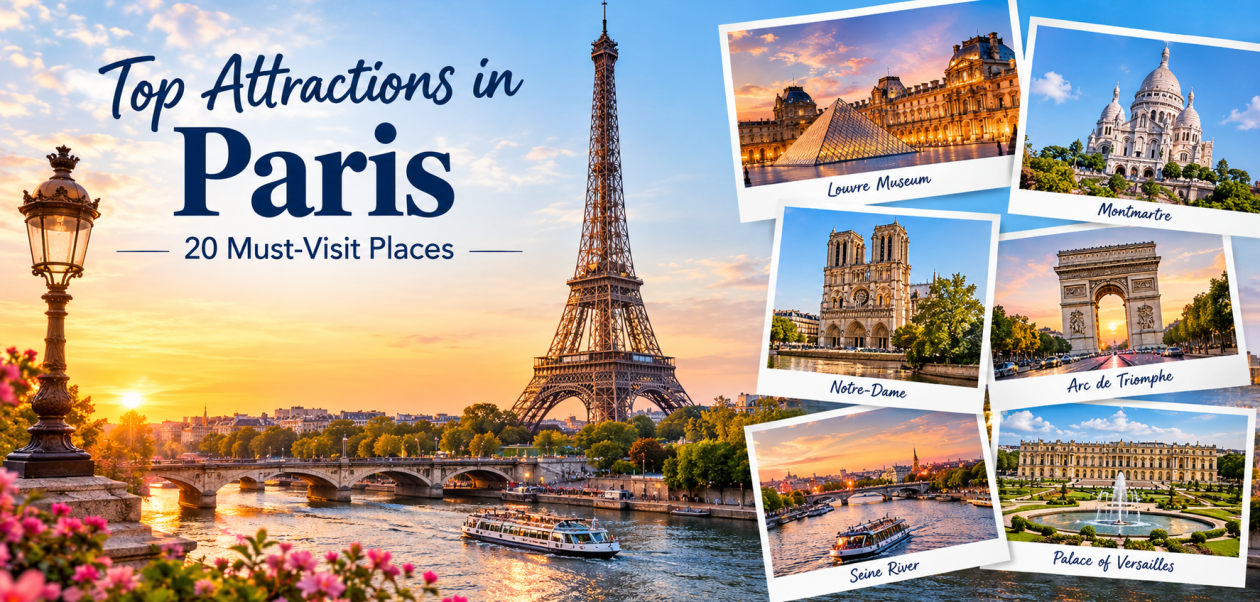
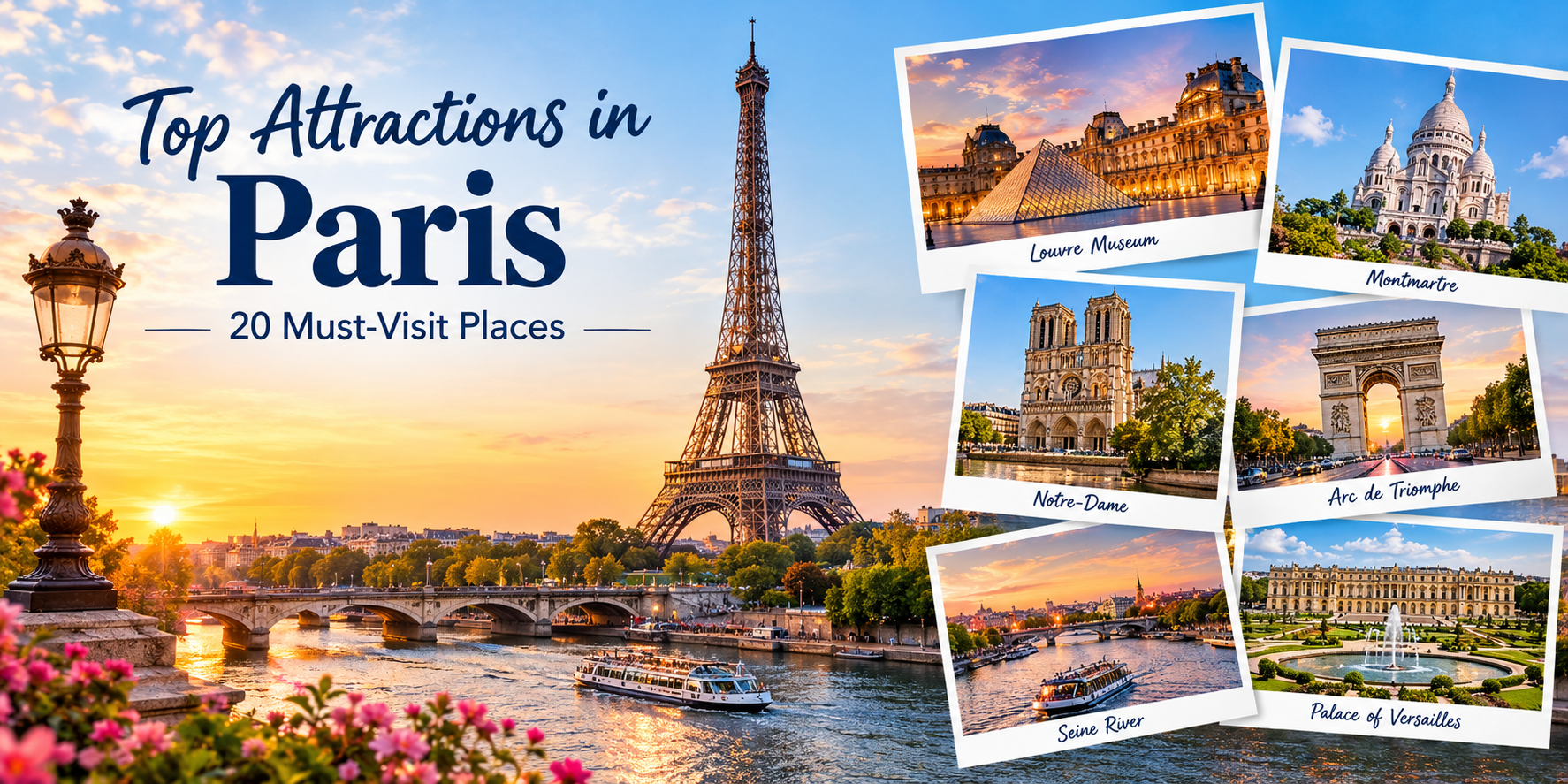
The Eiffel Tower is undoubtedly the most recognizable landmark in Paris and one of the world’s most famous structures.
Built for the 1889 World’s Fair, the tower offers impressive views across Paris. Visitors can admire the structure from the Champ de Mars and Trocadéro or purchase tickets to explore its different levels.
For many first-time visitors, seeing the Eiffel Tower illuminated after dark is an essential Paris experience.
Best for: First-time visitors, photography, city views, couples, and families.
Suggested time: 2–3 hours.
Travel tip: Reserve tickets ahead during busy periods if you plan to go inside the tower.
2. Louvre Museum
The Louvre is one of the world’s largest and most famous museums. Its enormous collection covers thousands of years of art and history.
The museum is home to internationally recognized works including Leonardo da Vinci’s Mona Lisa, the Venus de Milo, and Winged Victory of Samothrace.
Don’t try to see the entire museum in one visit. Choose a few collections or masterpieces that interest you and plan your route beforehand.
Best for: Art lovers, history enthusiasts, and first-time visitors.
Suggested time: 3–5 hours.
3. Notre-Dame Cathedral
Located on Île de la Cité, Notre-Dame is one of Paris’s most important historic landmarks.
The Gothic cathedral has played a major role in the history and cultural identity of the city. Following the devastating 2019 fire, extensive restoration work returned the cathedral to public use.
Its architecture, stained glass, towers, and riverside location make it an important stop on a Paris sightseeing itinerary.
Best for: Architecture, history, photography, and cultural tourism.
Suggested time: 1–2 hours.
4. Arc de Triomphe
Standing at the western end of the Champs-Élysées, the Arc de Triomphe is another iconic Paris landmark.
The monument commemorates French military history, while its rooftop provides sweeping views over the city’s famous avenues.
From above, visitors can appreciate the unusual star-shaped street layout surrounding the monument.
Best for: Panoramic views and architecture.
Suggested time: 1–1.5 hours.
5. Montmartre and Sacré-Cœur
Montmartre offers a very different experience from the grand museums and monuments of central Paris.
The historic hilltop neighborhood is famous for its artistic heritage, winding streets, cafés, boutiques, and lively atmosphere. At the top stands the white-domed Sacré-Cœur Basilica.
Take time to explore the surrounding streets instead of visiting only the basilica.
Best for: Art, photography, romantic walks, and neighborhood exploration.
Suggested time: 2–4 hours.
Travel tip: Wear comfortable shoes because the area has steep streets and many stairs.
6. Musée d’Orsay
Housed in a former railway station, the Musée d’Orsay is particularly famous for its collection of Impressionist and Post-Impressionist art.
Visitors can see works associated with artists such as Claude Monet, Edgar Degas, Pierre-Auguste Renoir, Paul Cézanne, and Vincent van Gogh.
Its smaller size compared with the Louvre also makes it easier to explore during a short trip.
Best for: Art lovers and Impressionist enthusiasts.
Suggested time: 2–3 hours.
7. Sainte-Chapelle
Sainte-Chapelle is one of the most remarkable Gothic monuments in central Paris.
Its greatest attraction is the collection of enormous stained-glass windows in the upper chapel. When sunlight passes through the colorful glass, the interior becomes particularly striking.
Because Sainte-Chapelle is close to Notre-Dame, the two attractions can easily be combined.
Best for: Architecture, history, and photography.
Suggested time: Around 1 hour.
8. Seine River
The Seine is an essential part of the Paris experience.
Walking beside the river gives visitors views of historic bridges, monuments, and some of the city’s most recognizable buildings. A sightseeing cruise offers another perspective and can be particularly enjoyable around sunset.
A Seine cruise can also be a convenient way to see several landmarks without spending hours walking between them.
Best for: Couples, families, photography, and relaxed sightseeing.
Suggested time: 1–2 hours.
9. Champs-Élysées
The Champs-Élysées is one of Paris’s most famous avenues.
Stretching between Place de la Concorde and the Arc de Triomphe, the avenue is lined with shops, restaurants, cafés, and major international brands.
It is especially convenient to visit alongside the Arc de Triomphe.
Best for: Shopping, sightseeing, and classic Paris views.
10. Palace of Versailles
Although located outside central Paris, the Palace of Versailles is one of the most popular excursions from the city.
The former royal residence is famous for its lavish interiors, Hall of Mirrors, extensive gardens, and connection to French royal history.
A visit to Versailles can take most of a day, particularly if you want to explore the gardens and wider estate.
Best for: History, architecture, gardens, and families.
Suggested time: Half day to full day.
11. Luxembourg Gardens
The Jardin du Luxembourg is one of Paris’s most pleasant green spaces.
Located in the heart of the city, the gardens feature formal landscaping, fountains, sculptures, tree-lined paths, and comfortable areas for relaxing.
It’s an excellent place to take a break after visiting the nearby Latin Quarter and Panthéon.
Best for: Families, couples, photography, and relaxing.
12. Panthéon
The Panthéon is a magnificent neoclassical monument in the Latin Quarter.
Originally conceived as a church, it became a mausoleum containing the remains of many prominent figures from French history.
Its enormous dome and impressive interior make it an interesting stop for travelers interested in French culture and architecture.
Best for: History and architecture.
13. Tuileries Garden
Located between the Louvre and Place de la Concorde, the Tuileries Garden is one of the easiest attractions to add to a central Paris itinerary.
The formal gardens contain sculptures, fountains, tree-lined paths, and seating areas.
After visiting the Louvre, walking through the Tuileries is a natural way to continue exploring central Paris.
Best for: Walking, photography, relaxation, and families.
14. Place de la Concorde
Place de la Concorde is one of the largest and most historically significant squares in Paris.
The Egyptian obelisk at its center is one of the square’s most recognizable features. Its location also makes it convenient for combining several attractions in one walking route.
Best for: Architecture, history, and sightseeing.
15. Palais Garnier
The Palais Garnier, home of the Paris Opera, is renowned for its lavish architecture and ornate interiors.
The grand staircase, decorative details, chandeliers, and ceiling make the building an attraction even for visitors who aren’t attending an opera performance.
Best for: Architecture, culture, photography, and performing arts.
16. Musée de l’Orangerie
Located beside the Tuileries Garden, Musée de l’Orangerie is particularly famous for Claude Monet’s enormous Water Lilies paintings.
The museum is relatively compact compared with the Louvre, making it a good option for travelers who want an art experience without spending an entire day inside a museum.
Best for: Impressionist art and Monet enthusiasts.
17. Centre Pompidou
The Centre Pompidou is known for both its modern and contemporary art collection and its distinctive architectural design.
Its colorful exterior pipes and exposed structural elements make it one of the most unusual major buildings in Paris.
Best for: Contemporary art and architecture.
Tip: Check current operating information before visiting because major cultural institutions may close temporarily for renovation.
18. Père Lachaise Cemetery
Père Lachaise is one of Paris’s most famous cemeteries and an unusual alternative to the city’s traditional attractions.
The cemetery contains elaborate tombs and is the final resting place of numerous famous figures from literature, music, art, and history.
Its peaceful paths also provide a different perspective on Paris.
Best for: History, architecture, photography, and quieter sightseeing.
19. Latin Quarter
The Latin Quarter is one of Paris’s most enjoyable areas to explore on foot.
The neighborhood is associated with the Sorbonne, historic streets, cafés, bookshops, and landmarks such as the Panthéon.
Instead of rushing through the area, allow time to wander and stop for coffee or lunch.
Best for: Walking, food, history, and local atmosphere.
20. Le Marais
Le Marais combines historic architecture with trendy cafés, boutiques, galleries, and restaurants.
The neighborhood also has important Jewish heritage and is closely associated with Paris’s LGBTQ+ community.
It’s an excellent area for travelers who want to experience Paris beyond the major monuments.
Best for: Food, shopping, history, culture, and neighborhood exploration.
Best Paris Attractions by Interest
| Travel Interest | Recommended Attractions |
| First-time visitors | Eiffel Tower, Louvre, Notre-Dame |
| Art lovers | Louvre, Musée d’Orsay, Musée de l’Orangerie |
| History | Versailles, Panthéon, Notre-Dame |
| Architecture | Sainte-Chapelle, Palais Garnier, Arc de Triomphe |
| Photography | Eiffel Tower, Montmartre, Seine |
| Families | Eiffel Tower, Seine cruise, Luxembourg Gardens |
| Shopping | Champs-Élysées, Le Marais |
| Romantic experiences | Seine cruise, Montmartre, Eiffel Tower |
| Neighborhood exploration | Montmartre, Le Marais, Latin Quarter |
| Gardens | Tuileries, Luxembourg Gardens, Versailles |
Best Time to Visit Paris
Paris can be visited throughout the year, but each season offers a different experience.
Spring
March through May brings pleasant conditions for sightseeing and colorful gardens. This is a popular period for walking tours and outdoor attractions.
Summer
June through August offers long daylight hours and a lively atmosphere. However, major attractions can be crowded, and accommodation prices may be higher.
Autumn
September through November can be an appealing period for museums, cafés, cultural attractions, and neighborhood walks.
Winter
December through February is colder, but travelers can spend more time exploring museums, restaurants, galleries, and indoor attractions.
Tip: Whatever season you choose, reserve popular attractions in advance when timed admission is available.
How to Get Around Paris
Paris has an extensive public transportation system, making it possible to explore the city without renting a car.
Métro
The Paris Métro is usually the fastest way to move between major areas.
Bus
Buses can be useful when you want to see the city while traveling between attractions.
RER
RER trains are particularly useful for destinations outside central Paris, including Versailles.
Walking
Walking is one of the best ways to discover neighborhoods such as Montmartre, Le Marais, Saint-Germain-des-Prés, and the Latin Quarter.
Taxi and Ride Services
These can be useful when traveling with luggage, with children, or late at night.
Practical tip: Group nearby attractions together. For example, visit the Louvre, Tuileries Garden, Place de la Concorde, and Champs-Élysées in one general sightseeing route.
Where to Stay in Paris
Choosing the right neighborhood can make sightseeing considerably easier.
Luxury:
Located on Rue de Rivoli near the Louvre and Tuileries Garden, Le Meurice is suited to travelers looking for a luxury stay in central Paris.
Mid-Range:
Located in the 2nd arrondissement, this stylish property suits travelers who want a central location with easy access to restaurants, cafés, shopping, and public transportation.
Budget:
This hostel-style property is suited to budget-conscious travelers who prioritize affordability and social facilities.
Booking tip: When comparing hotels, check the distance to the nearest Métro station as well as the hotel’s distance from individual attractions.
Paris Travel Essentials
| Essential | Information |
| Currency | Euro (€) |
| Language | French |
| Power plugs | Type C and E |
| Transportation | Métro, RER, buses, taxis |
| Emergency number | 112 |
| Time zone | Central European Time / Central European Summer Time |
| Cards | Widely accepted |
| Internet | Local SIM or eSIM can be useful |
Visa Information
France is part of the Schengen Area. Visa requirements depend on your nationality, travel purpose, and length of stay.
Always check current requirements through official French or European government resources before booking your trip.
Suggested 3-Day Paris Itinerary
Day 1: Eiffel Tower and Central Paris
Morning
- Eiffel Tower
- Trocadéro
- Champ de Mars
Afternoon
- Seine walk
- Louvre Museum
- Tuileries Garden
Evening
- Seine cruise
- Dinner in central Paris
Day 2: Historic Paris
Morning
- Notre-Dame
- Sainte-Chapelle
- Île de la Cité
Afternoon
- Latin Quarter
- Panthéon
- Luxembourg Gardens
Evening
- Saint-Germain-des-Prés
Day 3: Montmartre and the Right Bank
Morning
- Sacré-Cœur
- Montmartre
Afternoon
- Musée d’Orsay
- Champs-Élysées
Evening
- Arc de Triomphe
- Dinner near your accommodation
Estimated Paris Travel Budget
| Travel Style | Approximate Daily Budget |
| Budget | €70–€120 |
| Mid-range | €150–€250 |
| Luxury | €350+ |
These are broad planning estimates. Accommodation, restaurant choices, attraction tickets, travel season, and transportation can significantly change the final cost.
Practical Tips for Visiting Paris
Book popular attractions early
The Eiffel Tower, Louvre, Versailles, and other major attractions can become busy, particularly during peak travel periods.
Don’t overpack your itinerary
Trying to visit six or seven major attractions in a single day can make your trip exhausting. Three or four main stops with time for meals and walking is often more enjoyable.
Wear comfortable shoes
Paris is a walking city. Comfortable footwear will make exploring historic neighborhoods much easier.
Use public transportation
The Métro and other public transport options make it relatively easy to move around the city.
Keep belongings secure
As in any busy tourist destination, remain aware of your belongings in crowded attractions, stations, and public transportation.
Learn basic French phrases
Simple phrases such as bonjour, merci, s’il vous plaît, and au revoir are useful during everyday interactions.
Explore beyond the landmarks
Don’t spend your entire trip moving between famous monuments. Allow time for neighborhood cafés, markets, parks, bookstores, and local streets.
Sustainable Travel in Paris
Paris is relatively easy to explore without a private car.
Travelers can reduce their environmental impact by:
- Using public transportation.
- Walking between nearby attractions.
- Supporting independent restaurants and local businesses.
- Carrying a reusable water bottle.
- Avoiding unnecessary single-use items.
- Exploring less-crowded neighborhoods.
- Choosing accommodations close to public transportation.
Frequently Asked Questions
What are the top attractions in Paris?
Some of the most popular attractions include the Eiffel Tower, Louvre Museum, Notre-Dame Cathedral, Arc de Triomphe, Montmartre, Musée d’Orsay, Sainte-Chapelle, and Palace of Versailles.
How many days are enough for Paris?
Three days is enough to see several major attractions, while four to five days allows a more relaxed itinerary with additional museums, neighborhoods, and day trips.
What should first-time visitors see in Paris?
First-time visitors often prioritize the Eiffel Tower, Louvre, Notre-Dame, Montmartre, Seine River, Arc de Triomphe, and Musée d’Orsay.
Is the Eiffel Tower worth visiting?
The Eiffel Tower is an iconic part of Paris and offers impressive city views. Even travelers who don’t go inside can enjoy excellent views of it from Trocadéro and other parts of the city.
Which attractions in Paris should be booked in advance?
Timed admission is worth considering for popular attractions such as the Eiffel Tower, Louvre Museum, and Versailles, particularly during busy travel periods.
What is the best area to stay in Paris?
Central areas such as the 1st, 4th, 5th, and 6th arrondissements can be convenient for sightseeing, while areas such as Montmartre and Le Marais offer a stronger neighborhood atmosphere.
Is Paris suitable for families?
Yes. Families can combine landmarks with parks, boat cruises, museums, and neighborhood walks. Keeping the daily schedule manageable is particularly helpful when traveling with children.
Can Versailles be visited from Paris in one day?
Yes. Versailles is a popular day trip from Paris. Travelers should allow at least half a day, and preferably most of a day, to explore the palace and gardens.
What are some free things to do in Paris?
Walking along the Seine, exploring neighborhoods such as Montmartre and Le Marais, and visiting many public gardens and squares can be enjoyed without a general admission fee. Individual attractions within these areas may charge admission.
Conclusion
Paris offers far more than a collection of famous monuments. The Eiffel Tower and Louvre may be essential stops for first-time visitors, but the city’s character also comes from its historic neighborhoods, gardens, museums, cafés, and riverside walks.
For a first trip, focus on a manageable combination of major attractions such as the Eiffel Tower, Louvre, Notre-Dame, Montmartre, and Seine. If you have more time, add Versailles, Musée d’Orsay, Le Marais, the Latin Quarter, and some of Paris’s quieter gardens and cultural attractions.
The best Paris itinerary is not necessarily the one with the most attractions. Leave enough time to slow down, explore on foot, enjoy a French meal, and experience the city between the famous sights.
Continue exploring TravioPlus for more Paris travel guides, itineraries, hotel recommendations, and practical tips to help plan your trip.