

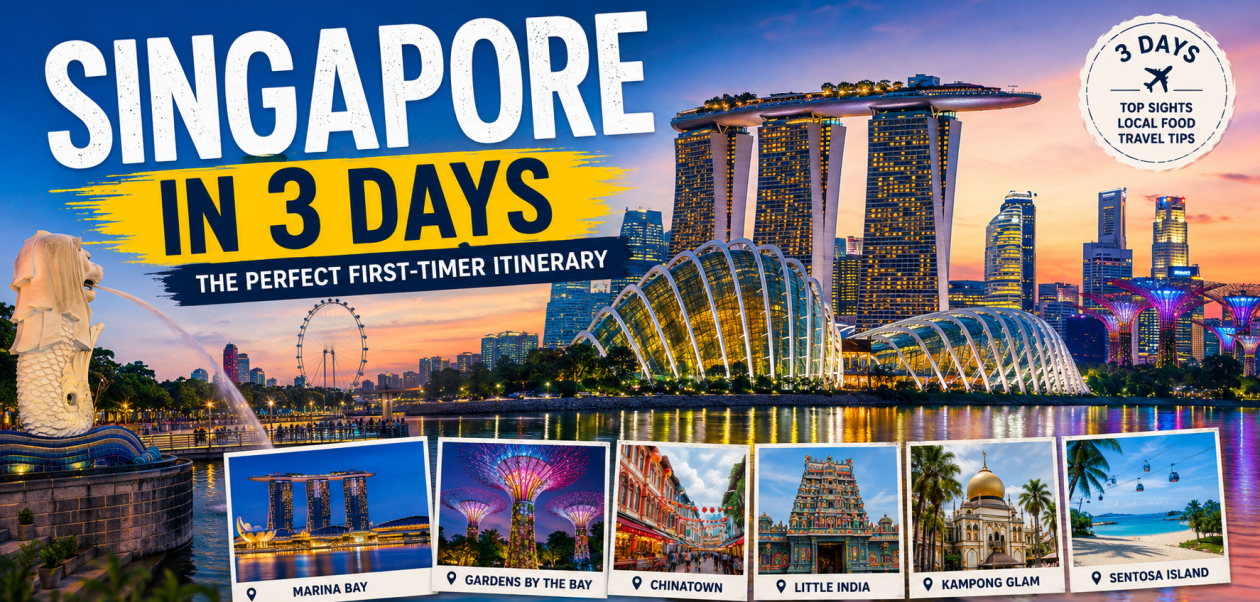
Singapore may be small, but three days is enough to experience many of its biggest attractions, eat your way through its famous hawker centres and explore several of its distinctive cultural neighborhoods.
The trick is not to treat Singapore like a checklist.
Instead, organize each day around a different part of the city. Spend one day discovering Marina Bay and Singapore’s futuristic skyline, another exploring its multicultural neighborhoods and food scene, and the final day enjoying Sentosa or choosing a slower alternative.
This Singapore 3-day itinerary is designed for first-time visitors who want a balanced trip covering major sights, local culture, food, shopping and a little relaxation.
Singapore in 3 Days at a Glance
| Day | Main Areas | Highlights |
|---|---|---|
| Day 1 | Marina Bay & Civic District | Merlion, Marina Bay Sands, Gardens by the Bay, Supertrees |
| Day 2 | Chinatown, Little India & Kampong Gelam | Temples, markets, heritage, hawker food |
| Day 3 | Sentosa | Beaches, attractions, cable car, sunset |
| Evening | Various | Hawker centres, rooftop views or Clarke Quay |
Best approach
Stay somewhere close to an MRT station and group attractions geographically. Singapore’s public transport network makes this particularly easy, and the Singapore Tourist Pass offers unlimited travel on public buses, MRT and LRT trains for one, two or three days.
Day 1: Marina Bay, Gardens by the Bay & Singapore Skyline
Your first day introduces the modern face of Singapore.
Start early, explore the Civic District and Marina Bay during the cooler part of the morning, then save Gardens by the Bay for late afternoon and evening.
Morning: Merlion Park & Marina Bay
Begin at Merlion Park, one of Singapore’s most recognizable landmarks.
The waterfront gives you excellent views across Marina Bay toward Marina Bay Sands.
Spend some time walking along the waterfront before continuing toward the Civic District.
Nearby sights
- Merlion Park
- Jubilee Bridge
- Esplanade
- The Fullerton Hotel
- Asian Civilisations Museum
- National Gallery Singapore
You don’t need to visit every museum on a three-day trip. Pick one if you are interested in art, history or architecture and save the rest for another visit.
Quick Tip
Singapore can become hot and humid surprisingly early in the day. Start sightseeing around 8:00–9:00 a.m. when possible.
Late Morning: Marina Bay Sands
Walk toward Marina Bay Sands, Singapore’s iconic integrated resort.
The complex is home to restaurants, shopping, entertainment and the SkyPark Observation Deck. The ArtScience Museum is another option if you prefer museums and design to panoramic views.
The SkyPark offers sweeping views across Singapore’s skyline, while the ArtScience Museum focuses on exhibitions at the intersection of art, culture, science and technology.
Should you visit the SkyPark?
Yes, if: you enjoy city views and photography.
Skip it if: you are traveling on a tight budget or would rather spend your time outdoors.
Lunch: Try Singaporean Hawker Food
For lunch, skip the expensive restaurants and head to a hawker centre.
Singapore’s food culture is one of the highlights of visiting the city.
Try:
- Chicken rice
- Laksa
- Char kway teow
- Hainanese chicken rice
- Hokkien mee
- Satay
- Roti prata
- Kaya toast
Don’t worry if you don’t recognize every dish. Singapore’s hawker centres are one of the easiest places to sample several local specialties in one meal.
Afternoon: Gardens by the Bay
After lunch, make your way to Gardens by the Bay.
This enormous waterfront garden is one of Singapore’s signature attractions. The complex includes the Flower Dome, Cloud Forest and Supertrees.
The Cloud Forest is particularly impressive, with its huge indoor waterfall and highland vegetation, while the Flower Dome showcases plants from different regions around the world.
Allow around 2–4 hours
If you’re visiting both conservatories and the Supertrees, don’t rush.
This is one of those Singapore attractions where slowing down improves the experience.
Evening: Supertree Grove Light Show
Stay until after sunset.
The Supertrees are illuminated after dark, creating one of Singapore’s most memorable nighttime scenes. Gardens by the Bay’s Garden Rhapsody is a regular light-and-sound experience.
Check the official Gardens by the Bay schedule before your visit because showtimes and attraction operations can change.
Dinner Options
After Gardens by the Bay, choose between:
Option 1 — Hawker centre: Best for budget travelers.
Option 2 — Marina Bay restaurant: Best for a special evening.
Option 3 — Clarke Quay: Best if you want riverside dining and nightlife.
Day 2: Chinatown, Little India & Kampong Gelam
Day two is about discovering the multicultural side of Singapore.
Instead of spending another day around skyscrapers, explore the neighborhoods that reveal the city’s Chinese, Indian and Malay heritage.
Morning: Chinatown
Start your morning in Chinatown.
Walk through the historic streets and explore the area’s temples, shops, cafés and food stalls.
Chinatown is one of Singapore’s major conserved historic districts and is closely associated with the city’s early Chinese immigrant communities.
Things to see
- Buddha Tooth Relic Temple
- Chinatown Street Market
- Chinatown Complex
- Sri Mariamman Temple
- Traditional shophouses
Take your time here rather than rushing from attraction to attraction.
The architecture and street scenes are part of the experience.
Lunch: Chinatown Complex
For an affordable local lunch, consider eating at a hawker centre rather than a restaurant.
This is a good opportunity to try dishes you didn’t have on Day 1.
What to order
- Chicken rice
- Char siu rice
- Laksa
- Dumplings
- Noodles
- Fresh fruit juice
If you see a long queue at a popular stall, that’s often a useful clue—but don’t assume a queue automatically means the food is right for you.
Afternoon: Little India
Take the MRT toward Little India.
This colorful neighborhood is filled with Indian restaurants, temples, shops and distinctive architecture.
Visit Sri Veeramakaliamman Temple, explore the streets around Serangoon Road and stop for a traditional Indian meal or snack.
Don’t miss
- Sri Veeramakaliamman Temple
- Tan Teng Niah
- Serangoon Road
- Tekka Centre
- Indian restaurants and sweet shops
Little India is particularly photogenic, with colorful façades and detailed religious architecture.
Late Afternoon: Kampong Gelam
Continue toward Kampong Gelam, one of Singapore’s most atmospheric heritage districts.
The neighborhood is known for Sultan Mosque, colorful shophouses, independent boutiques, cafés and restaurants.
Singapore’s tourism board describes Kampong Gelam as a historic precinct with a mix of culinary, cultural and shopping experiences.
Spend time around Haji Lane
Haji Lane is popular for:
- Street art
- Independent shops
- Cafés
- Restaurants
- Bars
- Photography
It’s compact, so you don’t need several hours here.
Evening: Singapore Night Food Experience
For your second evening, make food the main event.
You could:
Option 1: Hawker centre
Best for an affordable and authentic meal.
Option 2: Food tour
A guided food tour can be worthwhile if you want to understand the history behind Singapore’s dishes.
Option 3: Clarke Quay
Head toward Clarke Quay for restaurants, riverside views and nightlife.
Option 4: Singapore River Cruise
A river cruise can be a relaxing way to see the illuminated city after dark.
Day 3: Sentosa Island
Your third day gives you a change of pace.
Leave the central business district behind and spend the day on Sentosa, Singapore’s resort island.
Sentosa offers beaches, attractions, adventure activities, restaurants and resorts. The main access point is around HarbourFront, and the island is easily connected to the city by public transport.
Morning: Travel to Sentosa
Take the MRT to HarbourFront.
From there, you have several options for reaching Sentosa:
- Sentosa Express
- Walk across Sentosa Boardwalk
- Cable car
- Taxi/private transfer
The cable car is the most scenic option, while walking is useful for budget-conscious travelers.
Morning to Afternoon: Choose Your Sentosa Experience
Don’t try to do everything.
Choose one major ticketed attraction and combine it with the beaches and outdoor areas.
Option A: Universal Studios Singapore
Best for:
- Families
- Theme-park fans
- Travelers with children
- Thrill seekers
Option B: Singapore Oceanarium
Best for:
- Families
- Marine-life enthusiasts
- Travelers wanting an indoor activity
Option C: Skyline Luge
Best for:
- Couples
- Families
- Adventure seekers
Option D: Beach day
Best for:
- Couples
- Slow travelers
- Anyone who has already seen Singapore’s major attractions
Sentosa currently offers a broad range of activities, including Universal Studios Singapore, Singapore Oceanarium, Skyline Luge, beaches, cable-car rides and other adventure attractions.
Afternoon: Sentosa Beaches
If you’re not spending the whole day inside a ticketed attraction, explore the beaches.
Siloso Beach
Best for: Activities, restaurants and a lively atmosphere.
Palawan Beach
Best for: Families and casual beach time.
Tanjong Beach
Best for: A quieter atmosphere.
Sentosa’s three principal beaches have distinct personalities, making it easy to choose one based on how you want to spend the afternoon.
Sunset: Return to Central Singapore
Return to the mainland before dinner.
If you want one final Singapore skyline experience, consider a rooftop bar or waterfront restaurant.
Alternatively, head back to a hawker centre and have one final inexpensive meal before your trip ends.
Alternative Day 3: Singapore for Slow Travelers
Not interested in Sentosa?
Don’t force it.
A slower third day can be more rewarding if you’ve already visited theme parks or beaches elsewhere in Southeast Asia.
Morning
Visit the Singapore Botanic Gardens.
Afternoon
Explore Orchard Road and nearby neighborhoods.
Evening
Have dinner around Marina Bay or Chinatown.
This version works particularly well for:
- Couples
- Older travelers
- Repeat visitors
- Travelers who dislike theme parks
- Visitors traveling during very hot or rainy weather
Where to Stay in Singapore for 3 Days
For a short trip, location matters more than saving a small amount on accommodation.
Ideally, stay close to an MRT station.
Luxury:
Marina Bay
Best for: Couples, honeymooners and travelers celebrating a special occasion.
Staying around Marina Bay puts you close to major attractions and gives you easy access to the waterfront.
You’ll pay a premium, but the location can save significant travel time during a three-day trip.
Mid-Range:
Bugis
City Hall
Best for: First-time visitors who want convenience without paying Marina Bay prices.
These areas offer easy access to several neighborhoods, restaurants and MRT connections.
Budget:
Chinatown
Little India
Best for: Backpackers and value-conscious travelers.
These neighborhoods offer hostels, guesthouses and affordable hotels while keeping you close to public transport and food.
Hotel Booking Tip
For only three nights, prioritize:
- MRT access
- Cleanliness
- Reviews
- Air conditioning
- Luggage storage
- Breakfast availability
A hotel that is slightly more expensive but located next to an MRT station can be better value than a cheaper property requiring multiple daily taxi rides.
Getting Around Singapore
Singapore is one of the easiest cities in Southeast Asia to navigate without a car.
MRT
The MRT should be your main form of transportation.
It’s fast, extensive and particularly useful for a three-day itinerary.
Bus
Buses fill gaps between MRT stations and are useful for shorter journeys.
Walking
Several neighborhoods are best explored on foot.
Chinatown, Little India, Kampong Gelam and Marina Bay can all be combined with walking.
Taxi and Ride-Hailing
Use taxis or ride-hailing services when:
- You’re carrying heavy luggage
- Traveling in a group
- It’s raining heavily
- You’re returning late at night
- A public transport route would require several changes
Singapore Tourist Pass
The Singapore Tourist Pass provides unlimited travel on public buses, MRT and LRT trains for one, two or three days.
However, don’t automatically buy one.
If you’re staying near an MRT station and doing a lot of walking, calculate whether unlimited travel will actually save money.
What to Eat in Singapore in 3 Days
Singapore deserves more than a quick food stop.
Must-Try Dishes
| Dish | What It Is |
|---|---|
| Hainanese Chicken Rice | Poached or roasted chicken with fragrant rice |
| Laksa | Spicy noodle soup with a rich coconut-based broth |
| Char Kway Teow | Stir-fried flat rice noodles |
| Hokkien Mee | Stir-fried noodles with seafood |
| Satay | Grilled skewered meat with peanut sauce |
| Kaya Toast | Toast with coconut-egg jam |
| Roti Prata | Flaky South Indian-style flatbread |
| Chilli Crab | Crab served with a rich, spicy-sweet sauce |
Don’t Miss Breakfast
Try kaya toast with soft-boiled eggs and coffee for a classic Singaporean breakfast.
It’s inexpensive, filling and very different from a standard hotel breakfast.
How Much Does 3 Days in Singapore Cost?
Singapore can be expensive, but you don’t need a luxury budget to enjoy it.
Estimated daily budget per person
| Travel Style | Approx. Daily Budget |
|---|---|
| Budget | SGD 70–120 |
| Mid-range | SGD 150–280 |
| Comfortable | SGD 300–500 |
| Luxury | SGD 600+ |
These are planning estimates and can vary significantly depending on hotel prices, attraction tickets, dining choices and travel dates.
Budget travelers can save by:
- Staying in hostels or simple hotels
- Eating at hawker centres
- Using MRT and buses
- Walking between nearby attractions
- Choosing free attractions
- Booking major attractions in advance when appropriate
Where your money goes
Accommodation will usually be the biggest expense.
Food and public transportation can be much more manageable if you follow a local-style itinerary.
Best Time to Visit Singapore
Singapore has a tropical climate throughout the year, with high humidity, abundant rainfall and relatively consistent temperatures.
The country experiences the Northeast Monsoon from December to early March and the Southwest Monsoon from June to September, with inter-monsoon periods between them.
There is no completely dry season.
For a comfortable sightseeing trip
Pack for:
- Heat
- Humidity
- Sudden rain
- Strong air conditioning indoors
A compact umbrella is one of the most useful things you can carry.
What to Pack for Singapore
For a three-day trip, keep your luggage light.
Essentials
- Lightweight clothing
- Comfortable walking shoes
- Compact umbrella
- Sunglasses
- Sunscreen
- Reusable water bottle
- Small daypack
- Universal travel adapter
- Portable power bank
- Light layer for heavily air-conditioned places
For religious sites
Some temples and religious buildings have dress expectations. Carry clothing that provides reasonable coverage when visiting religious sites.
Practical Singapore Travel Information
Currency
Singapore dollar (SGD)
Credit and debit cards are widely useful, although having some cash can still be convenient for smaller purchases.
Language
Singapore has four official languages:
- English
- Mandarin
- Malay
- Tamil
English is widely used and is particularly useful for travelers.
Power Plug
Singapore primarily uses Type G electrical sockets.
A universal adapter is recommended.
SIM & eSIM
An eSIM is convenient for a short trip if your phone supports eSIM technology.
For three days, a small data package is usually sufficient unless you plan to use heavy video streaming or hotspot services.
Visa & Entry Requirements
Visa requirements depend on your nationality and travel document.
Singapore’s Immigration & Checkpoints Authority states that travelers who require a visa must obtain one, while all travelers generally need a passport with at least six months’ validity. Foreign visitors must also submit the SG Arrival Card within three days before arrival, subject to the applicable exemptions.
The SG Arrival Card is not a visa and the official electronic submission is free.
Always check the current requirements for your passport before booking your trip.
Singapore Travel Tips for First-Time Visitors
1. Don’t underestimate walking
Singapore’s attractions may look close together on a map, but heat and humidity can make long walks tiring.
Combine walking with MRT journeys.
2. Carry an umbrella
Rain can arrive quickly.
3. Eat at hawker centres
Some of Singapore’s best-value food experiences are found outside upscale restaurants.
4. Book popular attractions strategically
If your schedule is fixed, check attraction availability and operating hours before arriving.
5. Don’t over-plan
Three days is short.
Trying to visit Sentosa, multiple museums, every shopping district and every famous restaurant will make the trip exhausting.
6. Respect local rules
Singapore has a reputation for strict regulations. Follow signs and local rules, particularly around public spaces, transportation and littering.
7. Use public transportation
For most visitors, renting a car is unnecessary.
8. Carry a reusable bottle
Singapore’s tropical climate means you’ll appreciate having water with you while sightseeing.
Singapore 3-Day Itinerary for Families
Traveling with children?
Adjust the itinerary slightly.
Day 1
Marina Bay → Gardens by the Bay → Supertrees
Children generally enjoy the conservatories and the outdoor Supertree area.
Day 2
Singapore Zoo or another family attraction → Chinatown → early dinner
Avoid trying to walk through several heritage neighborhoods in one afternoon if you’re traveling with young children.
Day 3
Sentosa → Singapore Oceanarium / Universal Studios → beach
Sentosa is the easiest day to dedicate entirely to family entertainment.
Singapore 3-Day Itinerary for Couples
For couples, replace some of the major attractions with slower experiences.
Day 1
Marina Bay → Gardens by the Bay → rooftop dinner
Day 2
Chinatown → Kampong Gelam → café hopping → Clarke Quay
Day 3
Sentosa → Tanjong Beach → sunset dinner
This version gives you more time to enjoy the city rather than constantly checking the clock.
Singapore 3-Day Itinerary for Budget Travelers
Day 1
Marina Bay → Merlion → Gardens by the Bay outdoor areas → hawker dinner
Day 2
Chinatown → Little India → Kampong Gelam → Haji Lane
Day 3
Sentosa beaches → free walking areas → Chinatown or hawker centre dinner
The key is to focus on Singapore’s free attractions and spend selectively on one or two paid experiences.
Free Things to Do in Singapore
Singapore doesn’t require a huge attraction budget.
Some excellent experiences are free or inexpensive:
- Walk around Marina Bay
- See the Merlion
- Explore Chinatown
- Visit Little India
- Walk through Kampong Gelam
- Explore Haji Lane
- Visit the outdoor areas of Gardens by the Bay
- Walk across the Helix Bridge
- Explore Singapore’s historic shophouses
- Relax on Sentosa’s beaches
The ticketed attractions are worth adding selectively rather than buying every available ticket.
Is 3 Days Enough for Singapore?
Yes—but only for a first taste.
Three days gives you enough time to experience:
- Singapore’s modern skyline
- Marina Bay
- Gardens by the Bay
- Historic neighborhoods
- Hawker food
- Sentosa
- Singapore’s excellent public transport
But Singapore rewards longer stays.
If you have five days, you can add more museums, nature attractions, shopping and day trips without rushing.
Pros and Cons of Visiting Singapore in 3 Days
Pros
- Excellent public transportation
- Very easy for first-time visitors
- Safe and organized
- Outstanding food
- Mix of modern and historic attractions
- Great for families
- Excellent airport connectivity
Cons
- Accommodation can be expensive
- Tropical humidity can be tiring
- Three days isn’t enough for every attraction
- Major attractions can become crowded
- Some experiences are significantly more expensive than the city’s hawker food
Sustainable Travel Tips
Singapore is compact, which makes responsible travel relatively straightforward.
Travel by public transport
Using MRT and buses instead of private vehicles reduces unnecessary road travel.
Carry a reusable bottle
Avoid buying single-use bottles throughout the day.
Support local food businesses
Hawker centres are an excellent way to experience Singaporean cuisine while supporting local vendors.
Don’t litter
Keep public areas clean and dispose of waste properly.
Explore beyond the obvious
Spreading your spending across different neighborhoods can help local businesses beyond the main tourist zones.
Singapore 3-Day Itinerary: Final Schedule
Day 1 — Modern Singapore
Morning: Merlion Park → Civic District
Lunch: Hawker centre
Afternoon: Marina Bay Sands → Gardens by the Bay
Evening: Supertree light show → Dinner
Day 2 — Cultural Singapore
Morning: Chinatown
Lunch: Chinatown hawker centre
Afternoon: Little India → Kampong Gelam
Evening: Haji Lane → Clarke Quay or local food experience
Day 3 — Island Escape
Morning: Sentosa
Afternoon: Universal Studios / Singapore Oceanarium / beaches
Evening: Sunset → Return to central Singapore
FAQ
Is 3 days enough for Singapore?
Yes. Three days is enough for a well-planned first visit covering Marina Bay, Gardens by the Bay, Chinatown, Little India, Kampong Gelam and Sentosa.
What is the best area to stay in Singapore for 3 days?
Marina Bay, City Hall, Bugis, Chinatown and areas near major MRT stations are convenient for a short stay.
How much money do I need for 3 days in Singapore?
Budget travelers can plan around SGD 70–120 per day excluding international flights, while mid-range travelers may spend around SGD 150–280 per day. Hotel prices can make the total considerably higher.
Is Singapore expensive?
Singapore can be expensive for accommodation and premium attractions, but public transport and hawker food provide relatively affordable options.
What should I not miss in Singapore?
For a first visit, prioritize Marina Bay, Gardens by the Bay, Singapore’s historic neighborhoods, hawker food and either Sentosa or another major attraction that matches your interests.
Can I visit Singapore without renting a car?
Absolutely. The MRT, buses, walking and occasional taxis or ride-hailing services are more than sufficient for most three-day itineraries.
What is the best month to visit Singapore?
Singapore can be visited year-round. It has a tropical climate with rainfall and high humidity throughout the year, so there is no guaranteed dry season.
Is Singapore good for families?
Yes. Singapore is particularly convenient for families because of its efficient public transport, wide range of attractions, family-friendly hotels and food choices.
Should I visit Sentosa for one day?
For first-time visitors with three days, Sentosa is a good choice if you enjoy beaches, theme parks, marine attractions or adventure activities. If those don’t interest you, use Day 3 for museums, nature or additional neighborhoods instead.
What is the emergency number in Singapore?
For police emergencies, call 999. For life-threatening ambulance or fire emergencies, call 995. Singapore’s government also lists 999 and 995 as the primary emergency numbers.
Conclusion
A Singapore trip in 3 days works best when you focus on experiences rather than trying to see everything.
Spend your first day around Marina Bay and Gardens by the Bay, where Singapore’s futuristic architecture takes center stage. Use the second day to discover Chinatown, Little India and Kampong Gelam, and make food a major part of the experience. On your final day, escape to Sentosa for beaches, attractions and a more relaxed atmosphere.
The city’s efficient public transportation makes this itinerary practical, while its mix of cultures, food and modern architecture ensures that even a short visit feels surprisingly varied.
If you’re planning a Singapore getaway, continue exploring TravioPlus for destination guides, hotel comparisons, travel tips, tours and practical advice to help you build the rest of your Southeast Asia trip.