

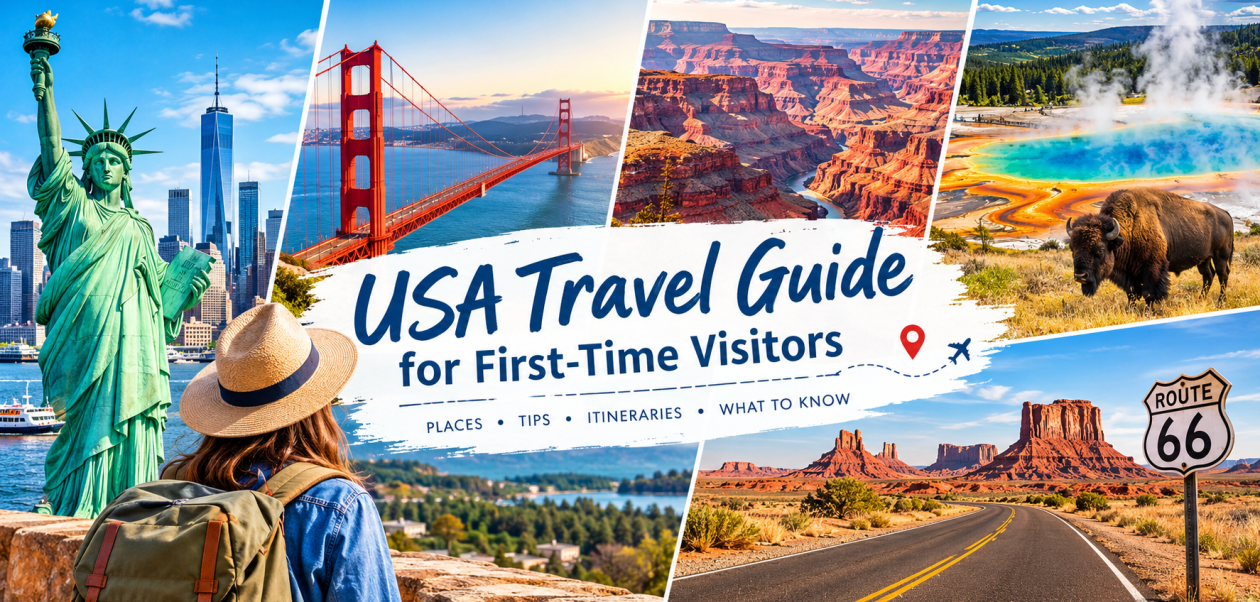
The United States is enormous, diverse, and surprisingly difficult to experience in a single trip. From the skyscrapers of New York City and beaches of California to the national parks of Utah and the wide-open landscapes of the American West, the country offers enough variety for dozens of vacations.
For first-time visitors, the biggest challenge isn’t finding things to do—it’s deciding where to go, how long to stay, and how to get around.
This USA travel guide covers the essentials, including the best destinations, transportation, accommodation, approximate costs, visa information, food, safety, and a practical first-trip itinerary.
Quick Facts About the USA
| Item | Information |
|---|---|
| Official name | United States of America |
| Capital | Washington, D.C. |
| Currency | U.S. Dollar (USD) |
| Language | English is the most widely spoken language |
| Time zones | Six main time zones across the country |
| Electricity | 120V, 60Hz |
| Plug type | Type A and Type B |
| Driving | Drive on the right |
| Emergency number | 911 |
| Tipping | Common in restaurants and many service industries |
| Best for | Cities, national parks, road trips, beaches, food and culture |
Why Visit the USA?
The United States is less a single travel destination than a collection of very different regions.
You can combine major cities, national parks, beaches, mountains, museums, theme parks, historic sites and road trips in the same vacation.
Highlights for First-Time Visitors
- New York City for iconic landmarks, museums, Broadway and food
- Washington, D.C. for American history and major museums
- Los Angeles for Hollywood, beaches and Southern California
- San Francisco for the Golden Gate Bridge and Bay Area
- Las Vegas for entertainment and access to the Southwest
- Orlando for theme parks and family vacations
- Miami for beaches, nightlife and Latin American influences
- Grand Canyon for spectacular desert scenery
- Yellowstone for wildlife and geothermal landscapes
- Yosemite for mountains, waterfalls and hiking
- Utah’s national parks for some of the country’s most dramatic scenery
Best Places to Visit in the USA for First-Time Travelers
Trying to visit the entire country in one trip is unrealistic. Instead, choose one region and explore it properly.
1. New York City
New York is one of the easiest places to introduce yourself to the USA.
First-time visitors can explore Times Square, Central Park, the Statue of Liberty, the Empire State Building, the Metropolitan Museum of Art and neighborhoods such as SoHo, Greenwich Village and Chinatown.
Recommended stay: 4–5 days
Best for: First-time visitors, culture, shopping, food and museums
2. Washington, D.C.
The U.S. capital is particularly rewarding for travelers interested in history and politics.
The National Mall connects many of the city’s major landmarks and museums, including the Lincoln Memorial, Washington Monument and Smithsonian museums.
Recommended stay: 2–3 days
Best for: History, museums and families
3. Los Angeles
Los Angeles is spread across a huge metropolitan area, so don’t expect to explore it entirely on foot.
Popular stops include Hollywood, Santa Monica, Venice Beach, Griffith Observatory and Beverly Hills.
Recommended stay: 3–4 days
Best for: Beaches, entertainment, movies and road trips
4. San Francisco
San Francisco offers a very different experience from Southern California.
See the Golden Gate Bridge, explore Fisherman’s Wharf and Chinatown, ride the city’s historic-style cable cars and consider a day trip to nearby wine country or Muir Woods.
Recommended stay: 3–4 days
Best for: City sightseeing, food, scenery and couples
5. Las Vegas
Las Vegas is famous for its casinos and entertainment, but it can also work as a base for exploring the Southwest.
The Grand Canyon, Hoover Dam and Valley of Fire are among the popular excursions from the region.
Recommended stay: 2–3 days
Best for: Entertainment, nightlife and Southwest road trips
6. Orlando
Orlando is particularly popular with families because of its major theme parks and entertainment attractions.
Allow several days if theme parks are the main reason for your trip.
Recommended stay: 4–7 days
Best for: Families and theme parks
7. National Parks
The USA’s national parks are among its greatest travel attractions.
Depending on your route, consider:
- Grand Canyon National Park
- Yellowstone National Park
- Yosemite National Park
- Zion National Park
- Bryce Canyon National Park
- Grand Teton National Park
- Rocky Mountain National Park
- Great Smoky Mountains National Park
For national parks, check official park websites before traveling because road conditions, reservations, seasonal closures and operating conditions can change.
Best Time to Visit the USA
There is no single best month for the entire country because the USA covers several climate zones.
Spring: March to May
Spring can be excellent for city trips and many southern destinations.
Good for: Washington, D.C., California, Southern states and city sightseeing.
Summer: June to August
Summer is popular for national parks, road trips and northern destinations. It is also a busy period for many attractions.
Good for: Yellowstone, Grand Teton, Alaska, New England and national parks.
Fall: September to November
Fall offers comfortable conditions in many regions and spectacular foliage in parts of the Northeast.
Good for: New England, New York, national parks and road trips.
Winter: December to February
Winter is ideal for ski destinations, holiday experiences and warmer southern destinations.
Good for: Florida, Southern California, Hawaii and ski resorts.
Quick Tip: Because weather varies dramatically, choose your destination first and then select the best travel season.
How to Get to the USA
Most international travelers arrive by air.
Major international gateways include:
- New York
- Los Angeles
- San Francisco
- Miami
- Chicago
- Atlanta
- Dallas/Fort Worth
- Houston
- Washington, D.C.
- Boston
When comparing flights, don’t look only at the ticket price. Check baggage allowances, airport location, connection times and the cost of reaching your final destination.
USA Visa and Entry Requirements
Entry requirements depend on your nationality, travel purpose and circumstances.
Most foreign nationals need a visa to visit the United States unless they qualify for visa-free travel under the Visa Waiver Program. Travelers using the Visa Waiver Program need an approved ESTA before traveling and can generally visit for tourism or business for up to 90 days.
Travelers who are not eligible for the Visa Waiver Program generally need an appropriate visitor visa, such as a B-2 or B-1/B-2 visa for tourism or combined tourism/business travel.
Entry rules can change, so check official U.S. government information before booking non-refundable travel.
Important: A visa or ESTA allows you to travel to a U.S. port of entry and request admission; it does not itself guarantee entry. Final admission is determined by U.S. Customs and Border Protection.
Official U.S. Visa Information
USA.gov: Visit the United States
How to Get Around the USA
Transportation is one of the most important things to understand before your first American trip.
Flying
For long distances, flying is usually the most practical option.
For example, traveling between New York and Los Angeles by car takes far longer than flying.
Consider domestic flights when your itinerary covers multiple distant regions.
Rental Cars
A rental car is extremely useful for:
- National park trips
- California road trips
- Southwest USA
- Florida
- Mountain destinations
- Smaller towns and rural areas
It is often unnecessary in dense cities such as New York City, where parking can be expensive and public transportation is extensive.
Trains
Amtrak operates passenger rail services across many parts of the United States.
Rail travel can be a comfortable way to see the country, but the network is not comparable to the high-speed rail systems found in some European and Asian countries.
Public Transportation
Major cities such as New York, Chicago, Boston, Washington, D.C. and San Francisco have useful public transportation systems.
In Los Angeles and many suburban areas, however, having a car can be more convenient.
Where to Stay in the USA
Accommodation varies enormously by destination.
For a first trip, staying relatively close to the attractions you want to visit can save substantial time.
Luxury Hotel
A landmark luxury hotel near Central Park and Fifth Avenue. It suits travelers looking for a classic New York experience and a central location.
Mid-Range Hotel
A practical option for travelers who prioritize location and modern amenities without choosing a traditional luxury property.
Budget Hotel
A compact, city-focused option that can suit travelers who plan to spend most of their time exploring rather than in their room.
Note: Hotel prices vary substantially by date, city, events and season. Compare current rates before booking.
Top Attractions for First-Time Visitors
Your attractions should depend on the region you choose.
New York
- Central Park
- Statue of Liberty
- Empire State Building
- Metropolitan Museum of Art
- Times Square
- Broadway
Washington, D.C.
- National Mall
- Lincoln Memorial
- Washington Monument
- Smithsonian museums
- U.S. Capitol area
California
- Golden Gate Bridge
- Yosemite National Park
- Santa Monica
- Hollywood
- Griffith Observatory
Southwest
- Grand Canyon
- Zion National Park
- Bryce Canyon
- Monument Valley
- Hoover Dam
Florida
- Orlando theme parks
- Miami Beach
- Everglades
- Florida Keys
Best Things to Do in the USA
Take an American Road Trip
A road trip is one of the best ways to experience parts of the USA outside major cities.
Popular routes include:
California Coast: San Francisco → Big Sur → Monterey → Santa Barbara → Los Angeles
Southwest: Las Vegas → Zion → Bryce Canyon → Grand Canyon
Northeast: New York → Philadelphia → Washington, D.C.
Plan realistic driving times and avoid packing too many destinations into one day.
Visit a National Park
National parks provide some of the country’s most memorable scenery.
Check official park information before traveling for seasonal road closures, permits, reservations and other requirements.
Experience American Food
Don’t limit yourself to burgers and fries.
Depending on the region, try:
- New York-style pizza
- Bagels
- Southern barbecue
- Cajun and Creole dishes
- Tex-Mex
- California cuisine
- New England seafood
- Chicago-style pizza
- Regional Mexican food
- American-style diners and breakfast
Tipping in the USA
Tipping is an important part of American service culture.
At restaurants with table service, tips are commonly expected, with the exact amount depending on service and circumstances.
Other situations where tipping may be customary include:
- Bartenders
- Hotel staff
- Taxi and rideshare drivers
- Tour guides
- Personal-service providers
Check your bill before paying because some establishments may already include a service charge or gratuity.
USA Travel Budget
The cost of a U.S. vacation varies considerably depending on the destination, accommodation level, season and transportation.
| Travel Style | Approx. Daily Budget* |
|---|---|
| Budget | $80–$140 |
| Mid-range | $150–$300 |
| Comfortable | $300–$500+ |
| Luxury | $500+ |
*Indicative planning ranges rather than fixed prices. International flights, major theme-park tickets, premium tours and some national-park expenses can add significantly to the total.
Typical Expenses
Accommodation: Often the largest daily expense in major cities.
Food: Budget travelers can save by mixing restaurants with supermarkets, food halls and casual dining.
Transportation: Costs depend heavily on whether you use public transportation, domestic flights or a rental car.
Attractions: Museums may be inexpensive or free in some cities, while theme parks and major entertainment attractions can be considerably more expensive.
Money, Cards and Cash
The official currency is the U.S. dollar (USD).
Credit and debit cards are widely accepted. Contactless payments are also common.
It’s still useful to carry a small amount of cash for situations where cards aren’t accepted or for certain tips.
Before departure:
- Tell your bank about international travel if required.
- Check foreign transaction fees.
- Keep a backup payment method.
- Store emergency payment information securely.
SIM and eSIM Advice
A local SIM or eSIM can make navigation, rideshare services and communication much easier.
For most travelers, an eSIM is convenient because it can be activated without replacing the physical SIM card.
Before purchasing one, check:
- Network coverage for your destinations
- Data allowance
- Hotspot availability
- Validity period
- Whether your phone is unlocked
If your itinerary includes remote national parks, remember that mobile coverage can be limited.
Travel Insurance
Travel insurance can be particularly valuable for trips to the USA because medical treatment can be extremely expensive.
Consider a policy that covers:
- Emergency medical treatment
- Hospitalization
- Trip cancellation
- Trip interruption
- Lost or delayed baggage
- Emergency transportation
Read the policy exclusions rather than choosing solely by the headline price.
Safety Tips for First-Time Visitors
The USA is generally straightforward for tourists, but normal travel precautions still apply.
Keep these habits in mind:
- Don’t leave valuables visible inside a rental car.
- Keep your passport secure.
- Be aware of your surroundings in crowded tourist areas.
- Use licensed transportation services.
- Follow local instructions in national parks.
- Check weather conditions before outdoor activities.
- Don’t underestimate driving distances.
- Keep emergency contact information accessible.
For emergencies, 911 is the standard number for police, fire and medical assistance.
Accessibility
Accessibility varies between cities, attractions and transportation systems.
Large cities and major tourist attractions generally offer accessible facilities, but older buildings, public transport stations and outdoor attractions may have limitations.
Travelers with accessibility requirements should check directly with hotels, airlines, attractions and transportation providers before booking.
Sustainable Travel Tips
Traveling responsibly in the USA can be surprisingly simple.
- Use public transportation when practical.
- Visit popular parks outside peak periods when possible.
- Stay on marked trails.
- Never feed wildlife.
- Carry reusable water bottles.
- Follow Leave No Trace principles.
- Support locally owned restaurants and businesses.
- Avoid unnecessary single-use plastics.
- Consider trains for suitable regional journeys.
10-Day USA Itinerary for First-Time Visitors
Trying to see New York, Los Angeles, Las Vegas, Miami and several national parks in 10 days would create an exhausting schedule.
A better approach is to focus on one region.
Option 1: New York + Washington, D.C.
Days 1–5: New York City
Days 6–8: Washington, D.C.
Days 9–10: Return to New York or depart from Washington, D.C.
This works well for travelers interested in history, culture, museums and city sightseeing.
Option 2: California
Days 1–3: San Francisco
Day 4: Monterey/Carmel
Day 5: Big Sur
Days 6–8: Los Angeles
Days 9–10: Santa Barbara or surrounding Southern California
This itinerary works particularly well as a road trip.
Option 3: Southwest USA
Days 1–2: Las Vegas
Days 3–4: Zion National Park
Day 5: Bryce Canyon
Days 6–7: Page/Monument Valley area
Days 8–9: Grand Canyon
Day 10: Return toward Las Vegas
This is best suited to travelers who enjoy scenery, hiking and road trips.
USA Travel Tips for First-Time Visitors
1. Don’t underestimate distances
The United States is huge. A destination that looks close on a map may require several hours of driving.
2. Plan around geography
Choose destinations that are close together rather than jumping randomly between opposite sides of the country.
3. Book popular accommodation early
Hotels in major cities and popular national-park gateways can become expensive during peak periods.
4. Don’t schedule every minute
Leave room for weather, traffic, delays and spontaneous discoveries.
5. Check attraction reservations
Popular museums, tours, observation decks and national parks may have timed-entry or reservation requirements.
6. Understand local taxes
Displayed prices don’t always represent the final amount you will pay. Sales taxes vary by state and locality, and hotel taxes can also apply.
7. Be prepared for tipping
Keep tipping customs in mind when creating your daily budget.
8. Check the weather
Weather varies enormously across the country—and can change quickly in mountainous areas.
9. Use travel apps
Useful apps can include:
- Google Maps or Apple Maps
- Airline apps
- Rideshare apps
- Hotel apps
- National park apps/websites
- Weather apps
10. Keep your itinerary realistic
For a first visit, experiencing two or three destinations properly is usually more enjoyable than rushing through six or seven.
Packing List for Your First USA Trip
Your packing list should depend on the region and season.
Essentials
- Passport
- Visa/ESTA documentation, where applicable
- Travel insurance information
- Credit/debit cards
- Phone and charger
- Universal travel adapter
- Comfortable walking shoes
- Weather-appropriate clothing
- Reusable water bottle
- Prescription medicines
- Small daypack
For national parks and road trips, also consider:
- Sun protection
- Hiking shoes
- Lightweight layers
- Offline maps
- Portable power bank
- Refillable water container
Frequently Asked Questions
How many days do you need for a first trip to the USA?
For a first trip, 10–14 days provides enough time to explore one region without spending the entire vacation in transit. Longer trips allow you to combine multiple regions.
What is the best place to visit in the USA for first-time visitors?
There is no single destination that suits everyone. New York works well for travelers interested in iconic landmarks and culture, while California suits road-trip and coastal travelers. Families may prefer Orlando, while outdoor enthusiasts may prioritize national parks.
Is the USA expensive to visit?
It can be. Accommodation, rental cars, domestic flights and major attractions can significantly affect the budget. However, travelers can reduce costs by choosing mid-range accommodation, using public transportation where practical and planning ahead.
Do I need a visa to visit the USA?
It depends on your nationality and circumstances. Many travelers need a visitor visa, while citizens of Visa Waiver Program countries may qualify for visa-free travel with ESTA authorization.
Is public transportation good in the USA?
It varies by city. Public transportation is particularly useful in cities such as New York, Washington, D.C., Boston and Chicago. A car is generally more useful for many national parks and suburban or rural destinations.
Can I visit the USA without renting a car?
Yes. City-focused trips can be completed without a rental car, especially in destinations with strong public transportation. For national parks and road trips, however, a car is often much more practical.
What currency is used in the USA?
The U.S. dollar (USD) is the official currency.
What is the emergency number in the USA?
Dial 911 for police, fire or medical emergencies.
Should I buy travel insurance for the USA?
Travel insurance is worth considering, particularly because unexpected medical treatment can be costly. Check coverage limits, exclusions and emergency assistance before purchasing.
Final Thoughts
Your first USA trip doesn’t need to cover the entire country.
The smartest approach is to choose a region based on your interests, allow enough time to experience it properly and build your itinerary around geography rather than simply collecting famous destinations.
For city lovers, New York and Washington, D.C. offer an excellent introduction to American culture and history. California is ideal for a coastal road trip, while the Southwest delivers dramatic landscapes and national parks. Families may want to focus on Florida and its theme parks.
Most importantly, slow down and leave room for the unexpected. The USA is at its most rewarding when you have enough time to experience its neighborhoods, landscapes, food and local culture—not just photograph its most famous landmarks.
Before booking, verify current entry requirements, transportation schedules, attraction rules and seasonal conditions using official sources.
Continue exploring TravioPlus for destination guides, hotel ideas, itineraries and practical travel planning advice.